
The CDC Says Teens Are Doing Better. So Why Does Bedtime Still Feel Like a War Zone?
If you’ve ever fought with a teenager about handing over their phone at 10 p.m., the data doesn’t need to convince you of anything, you’ve already lived it. The “five […]
If you’ve ever fought with a teenager about handing over their phone at 10 p.m., the data doesn’t need to convince you of anything, you’ve already lived it. The “five more minutes” that turns into forty. The blue glow under the covers. The groggy, snappish kid at breakfast who swears they went to bed on time.
So here’s a headline that might catch you off guard: the CDC says teen mental health is actually improving. Fewer teens report persistent sadness. Fewer are seriously considering suicide. After a decade of grim headlines, the newest national data is, genuinely, good news.
But if your gut reaction was “then why doesn’t it feel that way in my house?”, you’re not wrong, and you’re not alone. Let’s dig into what the numbers really say, and what they’re conveniently leaving out.
The Breakdown
In September 2026, the CDC released new findings from its 2025 Youth Risk Behavior Survey, and the trend lines are genuinely encouraging [1][2]:
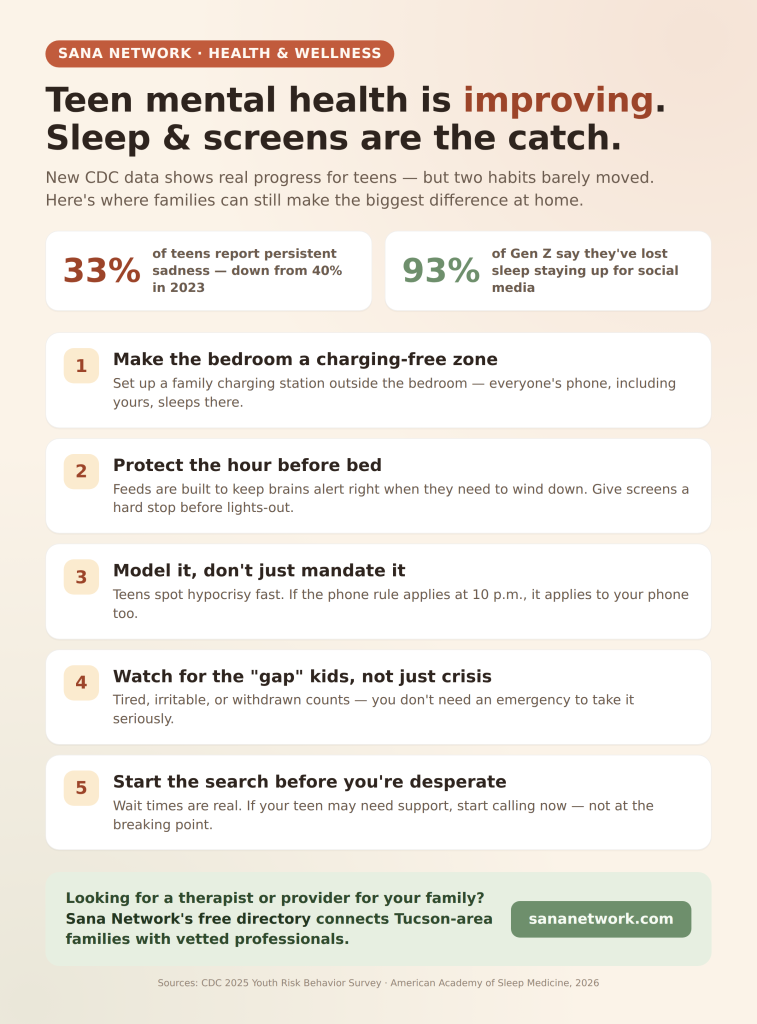
- Persistent sadness or hopelessness among high schoolers dropped from 40% in 2023 to 33% in 2025.
- Poor mental health reports fell from 29% to 23%.
- Seriously considering suicide dropped from 20% to 14%; suicide attempts fell from 9% to 6%.
- On the physical side, more teens are eating vegetables daily (58% → 63%), drinking water instead of soda, and playing on sports teams (52% → 58%).
That’s real progress, and it deserves to be said out loud, especially after the pandemic years put so many families through the wringer.
Here’s the fine print, though. Two numbers barely budged:
- Only 24% of students get the recommended 8+ hours of sleep on school nights.
- 36% of teens say they use social media “almost constantly.”
A separate national sleep survey found that 93% of Gen Z say they’ve lost sleep by staying up past their bedtime for social media [3]. That’s not a fringe group, that’s nearly everyone.
Experts quoted alongside the CDC release are also urging caution before we declare victory. School health leaders point out that if you strip out the depths of the pandemic years, the “improvement” mostly brings numbers back toward, not below, pre-pandemic levels [1]. And in 2025, the federal government canceled more than 200 school and community mental health grants, which advocates warn could stall or reverse this progress just as it’s taking hold [1].
The Human Connection
Here’s what I think is actually going on, and why “kids are fine now!” can feel so dissonant if you’re a parent: national averages don’t live in your house.
Your teenager isn’t a statistic trending in the right direction, they’re a specific kid who’s exhausted, glued to their phone at midnight, and maybe still anxious in ways that never show up as “seriously considered suicide” on a survey. A lot of real suffering lives in the gap between “in crisis” and “totally fine,” and that gap is exactly where chronic sleep loss and doomscrolling tend to set up camp.
There’s also a financial and logistical layer to this that rarely makes the headlines. If you’ve tried to get your kid in with a child therapist or psychiatrist recently, you know the drill: three-month waitlists, providers not accepting new patients, bills that run well over $150–$200 a session out of network [4]. One parent interviewed by PBS NewsHour spent more than $20,000 across a decade trying to find the right care for her son [4]. That’s not a fringe experience, it’s closer to the norm in a country with roughly one child psychiatrist for every 1,800 kids who need one [4].
So when a parent feels skeptical of a rosy national trend, that skepticism is coming from somewhere real: the sleep fights, the 2 a.m. scrolling, and the genuine hassle of finding help when you finally decide you need it.
Actionable Advice
The good news buried in all of this: sleep and screens are two of the most fixable levers you have, and you don’t need a national policy shift to move them at home this week.
- Make the bedroom a charging-free zone. Set up a family charging station in the kitchen or hallway, everyone’s phone, including yours, sleeps there. This one change does more for teen sleep than almost any lecture about “screen time.”
- Protect the hour before bed like it’s sacred. Not because screens are evil, but because algorithm-driven feeds are specifically engineered to keep brains alert right when they need to be winding down.
- Model it, don’t just mandate it. Teens are exquisitely sensitive to hypocrisy. If you want them off their phone at 10 p.m., they need to see you put yours down too.
- Watch for the “gap” kids, not just the crisis kids. Check in with teens who seem tired, irritable, or withdrawn, even when nothing looks like an emergency. Persistent low-grade stress is worth taking seriously before it escalates.
- Start the search for support before you’re desperate. Given real wait times, if you sense your teen could use professional support, start making calls now rather than waiting for a crisis. Ask your pediatrician, school counselor, or a local directory for providers who are actually taking new patients.
Find Support Locally
If that last tip feels daunting, that’s exactly the gap Sana Network exists to close. Our free directory connects Tucson-area families with vetted therapists, psychiatrists, coaches, and other wellness professionals — so you’re not stuck cold-calling a dozen offices while your kid is struggling in the meantime. Whether you’re looking for support for your teen, yourself, or your whole family’s wellbeing, you can search the directory anytime at sananetwork.com.
The national numbers are finally trending the right way. Let’s make sure your household gets there too.
Written by AI & Reviewed by Clinical Psychologist: Yoendry Torres, Psy.D.
Disclaimer: Some blog posts may contain affiliate links, earning Sana Network a commission at no additional cost to you. These recommendations reflect our honest opinions about products or services we find helpful and trustworthy. This content is informational and not legal nor medical advice; consult a an attorney or healthcare provider for personalized guidance.
Sources (for verification before publishing)
- CDC Newsroom, “CDC Data Show Encouraging Progress in Youth Health” (Sept. 2026), 2025 Youth Risk Behavior Survey — https://www.cdc.gov/media/releases/2026/cdc-data-show-encouraging-progress-in-youth-health.html
Additional context/quotes (funding cuts, pre-pandemic comparison): EdWeek, “Teen Mental Health Is Improving, CDC Finds. Then Why Are Experts Still Concerned?” — https://www.edweek.org/leadership/teen-mental-health-is-improving-cdc-finds-then-why-are-experts-still-concerned/2026/09 - CDC, “Youth Mental Health: The Numbers,” Adolescent and School Health — https://www.cdc.gov/healthy-youth/mental-health/mental-health-numbers.html
- American Academy of Sleep Medicine, “Are You TikTok Tired? 93% of Gen Z Admit to Staying Up Past Their Bedtime Due to Social Media” — https://aasm.org/are-you-tiktok-tired-93-of-gen-z-admit-to-staying-up-past-their-bedtime-due-to-social-media/
- PBS NewsHour, “Why parents are struggling to find mental health care for their children” — https://www.pbs.org/newshour/health/why-parents-are-struggling-to-find-mental-health-care-for-their-children
Note on sourcing: All statistics above are drawn directly from the cited sources. No figures were estimated or invented. The “one child psychiatrist per ~1,800 children” ratio and the $20,000/decade and $150–200/session figures are as reported by the parent and expert sources in the PBS NewsHour piece — worth a quick read-through before publishing to confirm you’re comfortable with how PBS sourced them, since they’re the one figure set that comes from a single article rather than a federal dataset.