
Your Insurance “Covers” Therapy. So Why Can’t Anyone Find a Therapist Who Takes It?
Picture this: your kid is struggling, maybe anxiety that’s turned into stomachaches before school, maybe a mood that’s gone from “moody teenager” to genuinely worrying. You do the responsible thing. […]
Picture this: your kid is struggling, maybe anxiety that’s turned into stomachaches before school, maybe a mood that’s gone from “moody teenager” to genuinely worrying. You do the responsible thing. You pull up your insurance company’s website, find the list of “in network” therapists, and start calling.
Call one: disconnected number. Call two: “I retired two years ago, sorry.” Call three: “We don’t take that plan anymore.” Calls four through ten: no response at all.
If that sounds familiar, you’re not imagining things and you’re not bad at this. People have been venting about this exact scenario across parenting forums, Reddit threads, and local Facebook groups for years, long lists of “in network” providers that turn out to be mostly fiction. There’s even a name for it: a “ghost network.” This month brought real news on exactly this problem, some encouraging, some frustrating.
The Breakdown
Here’s the official version first. Back in 2024, the Departments of Labor, Treasury, and Health and Human Services finalized strong new rules under the Mental Health Parity and Addiction Equity Act (MHPAEA). In plain English: insurers can’t make it meaningfully harder to get a mental health appointment than a medical one. No stricter prior authorization, no skimpier provider networks, and plans have to study their own data and fix it if mental health access lags behind. That part of the rule fully kicked in for most plans by January 2026. Good news, right?
Here’s the fine print. Just this month, the Department of Labor issued new enforcement guidance (Field Assistance Bulletin 2026-03) narrowing what regulators are actively going after: flat exclusions of mental health treatment, uneven medical necessity reviews, and inadequate networks. The newer, more granular documentation requirements from the 2024 rule stay unenforced while legal challenges play out, plus another 18 months after that.
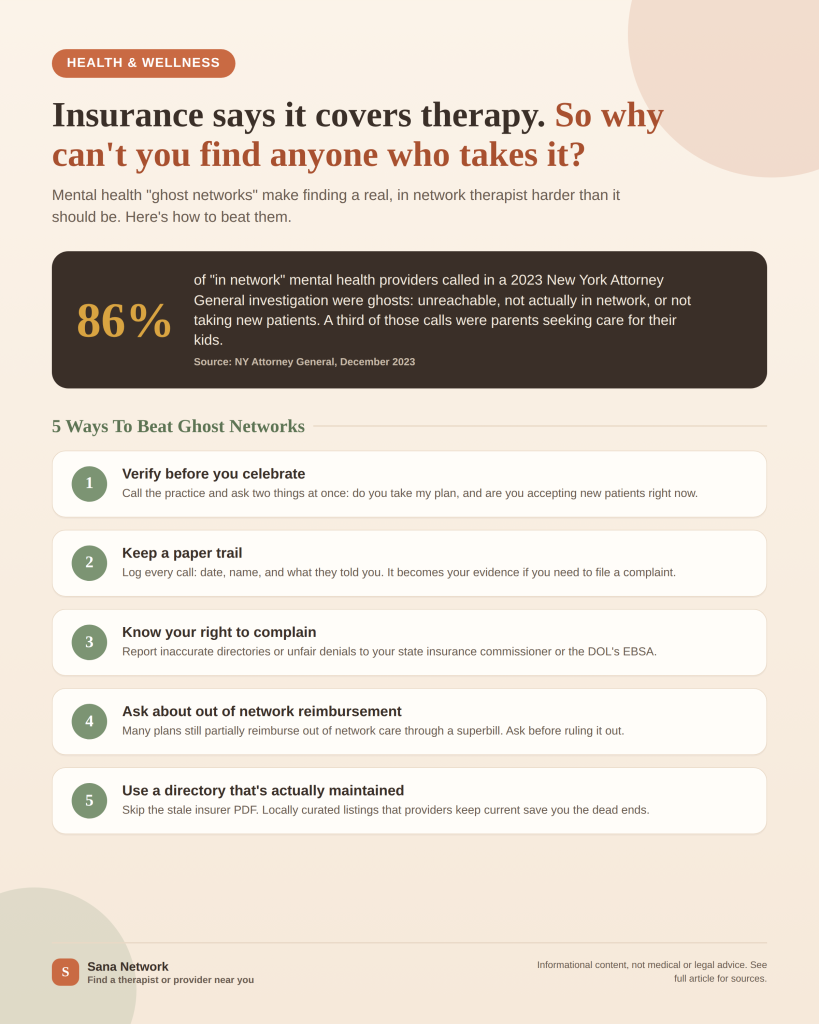
Translation: the law on paper is still strong, but for now, fewer people are actively checking the newest, most detailed version of it. That lines up uncomfortably with what families have reported for years. A 2023 investigation by the New York Attorney General’s office called hundreds of “in network” mental health providers listed by 13 major insurers. Eighty six percent were ghosts: unreachable, not actually in network, or not taking new patients. Only 14 percent could offer an appointment, and a full third of the test calls involved parents trying to get their kids seen.
Separately, actuarial research shows people go out of network for mental health and addiction care more than five times as often as for physical health care, simply because the “in network” options aren’t real.
The Human Connection
This isn’t just a paperwork problem. It’s a stress problem, and it hits families hardest.
When a kid is struggling, time matters. A two week wait can turn “let’s get ahead of this” into a full blown crisis. When a parent spends hours of limited energy calling a dead list of names, that’s hours not spent at work, with family, or resting. It’s exhausting in a way that’s hard to explain to anyone who hasn’t lived it.
There’s also a quiet layer of guilt underneath. A lot of parents internalize the runaround as a personal failure: “I should be able to figure this out.” You shouldn’t need a detective’s patience to get your kid help you’re already paying for through your premiums. The system is genuinely broken here, and knowing that can lift some of the self blame off your shoulders.
And there’s the financial piece. Faced with an empty in network list, plenty of families just pay out of pocket rather than wait, its own kind of stress stacked on an already stressful situation.
Actionable Advice
You can’t fix the whole system today, but you can stack the odds in your favor. Here’s where to start.
- Verify before you celebrate. Don’t trust the directory. Call (or message) the actual practice and ask two things in the same breath: “Do you take my plan?” and “Are you currently accepting new patients?” A “yes” to the first and a “no” to the second is still a dead end.
- Keep a paper trail. Log every call: date, who you spoke to, what they said. If you end up needing to file a complaint (more on that below), this log is your evidence, and it’s also oddly satisfying to have proof you did everything right.
- Know you have a right to complain, and use it. If your plan’s directory is inaccurate or you’re being denied mental health care that would be approved for a physical condition, you can file a parity complaint with your state insurance commissioner or the federal Department of Labor’s Employee Benefits Security Administration (EBSA). These complaints are part of how regulators find patterns worth acting on.
- Ask about out of network reimbursement before you rule it out. Many plans still offer partial reimbursement for out of network mental health care through a “superbill.” Ask a provider you like (even if they’re out of network) whether they provide one, then check your plan’s out of network benefits before assuming it’s unaffordable.
- Start with a directory that’s actually maintained, not just a PDF. Big insurer lists go stale fast. Smaller, locally curated directories where real providers keep their own listings current tend to be far more reliable than a giant spreadsheet nobody has updated in two years.
Finding Real Help, Not Just a List
If you’re in the Tucson area and you’re tired of calling ghosts, the Sana Network directory is built to be the opposite of that experience: real therapists, psychiatrists, naturopaths, and other wellness providers who keep their own listings current, so you’re not gambling your limited time and energy on a dead end. It’s a good next stop whether you’re looking for yourself, your partner, or your kid.
Written by AI & Reviewed by Clinical Psychologist: Yoendry Torres, Psy.D.
Disclaimer: Some blog posts may contain affiliate links, earning Sana Network a commission at no additional cost to you. These recommendations reflect our honest opinions about products or services we find helpful and trustworthy. This content is informational and not legal nor medical advice; consult a an attorney or healthcare provider for personalized guidance.