
Flu Season Is Back. Here’s What’s Actually Different This Year (and What Isn’t)
Remember last winter? If “record breaking flu season” brings back a flashback of a feverish kid on the couch, a sink full of dishes, and days of DoorDash you’re still […]
Remember last winter? If “record breaking flu season” brings back a flashback of a feverish kid on the couch, a sink full of dishes, and days of DoorDash you’re still paying off, you’re not alone. One mom described ordering takeout so often she joked, “I’m going to regret looking at my bank statement.” Another admitted her toddler got the run of the pantry and unlimited Disney+ because there simply wasn’t bandwidth for anything else.
That wasn’t an overreaction. Last season really was the worst flu season in 25 years by some measures, and it has a name: subclade K, nicknamed the “super flu” in headlines. Flu season is ramping up again, and a lot of people are walking in with their nerves already frayed from last time.
Here’s the good news and the not so simple news, without the panic.
The Breakdown
What actually happened last year. A mutated version of the H3N2 flu virus, subclade K, was first spotted in New York in June 2025, after that year’s flu shot had already been finalized. It had enough mutations to dodge some of the protection from the vaccine and from prior infection. The CDC estimated roughly 11 million illnesses, 120,000 hospitalizations, and 5,000 deaths that season, including nine children, and doctor visits for flu like illness hit their highest level in over 25 years.
It wasn’t a “worse” flu, just a lot more of it. The CDC has been clear there’s no evidence subclade K causes more severe illness per case. The problem was volume. So many people got infected at once that emergency rooms got slammed, and it felt like everyone you knew was sick simultaneously, because, largely, they were.
This year’s shot was built with subclade K in mind. All three strains in the 2026 to 2027 vaccine changed, and the H3N2 component was specifically updated to target last year’s surge virus. There’s also a new option: an mRNA flu vaccine from Moderna, approved for adults 50 and older, found in an early trial to be roughly 27% more effective than a standard shot. Supply is expected to be limited, so don’t be surprised if it’s not the first thing offered at the pharmacy.
Nobody actually knows how bad this season will be yet, and that’s the honest, slightly unsatisfying truth. Flu is famously unpredictable. Australia’s winter flu season, which often hints at what’s coming for the US, was notably milder in 2026 than its brutal 2025 season, but experts caution Southern Hemisphere trends don’t always translate north. Cautious optimism, not a guarantee.
One thing working against us: vaccination rates have been sliding. Coverage among children and teens dropped to around 43%, down from nearly 64% in 2019 to 2020, and coverage among adults 65 and older slipped too. Fewer vaccinated people means any flu strain has more room to spread.
The Human Connection
Here’s what doesn’t show up in a CDC data table: flu season is a full household event, and the toll isn’t just physical.
One writer described the specific guilt of calling in sick to work again, dreading the moment she’d have to explain it to her manager, worried about being seen as “a flakey, unreliable team member,” all while her arms ached from carrying a feverish toddler through the night. Another parent noted that being sick herself left “no room to recover” once her child got sick too, because caregiving doesn’t pause just because the caregiver also has a fever.
That combination, physical exhaustion plus the mental math of missed work, lost income, and who’s covering the kids, is its own stress, separate from the virus itself. It shows up as irritability, decision fatigue, and a quiet sense of falling behind at work and home at once. None of that makes you a bad parent or employee. It makes you a person managing an illness with no backup plan, which is exhausting even when nobody has a fever.
Actionable Advice
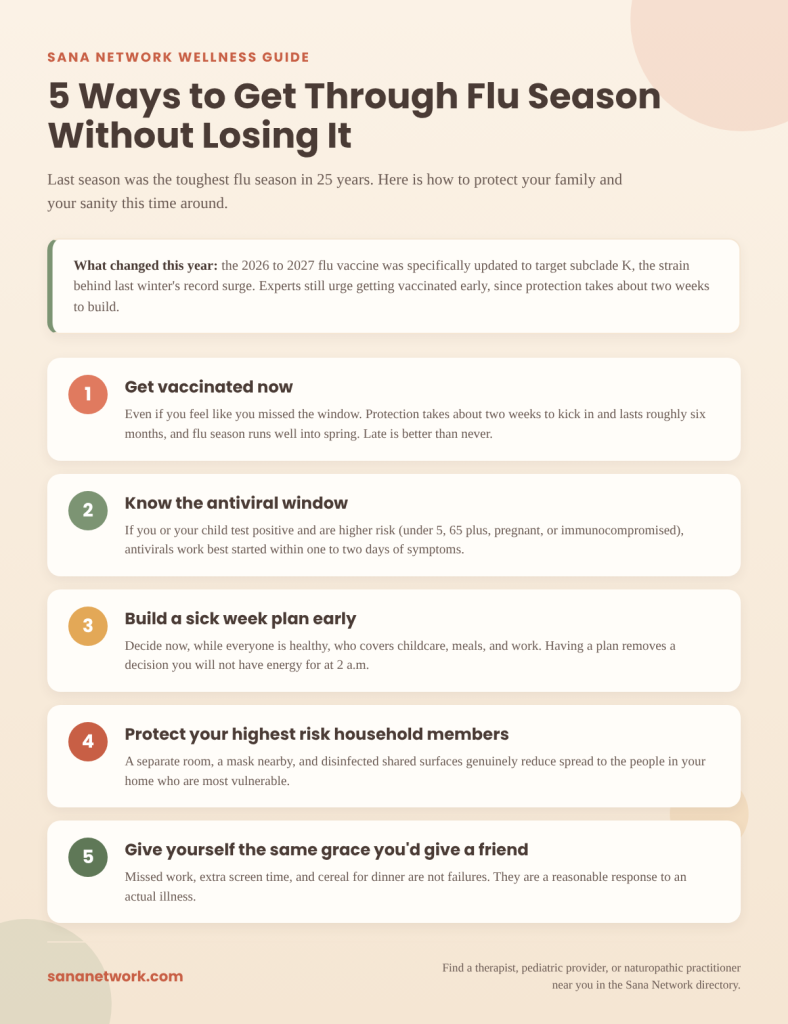
- Get vaccinated now, even if you feel like you missed the window. Protection takes about two weeks to kick in and lasts roughly six months, and flu season typically runs well into spring. Late is genuinely better than never here.
- Know the antiviral window. If you or your child test positive and are in a higher risk group (kids under 5, adults 65+, pregnant, or immunocompromised), antivirals work best started within one to two days of symptoms. Call your provider early rather than waiting it out.
- Build your “sick week” plan before you need it. Decide now, while everyone is healthy, who covers childcare, what the backup meal plan is (a stocked freezer beats a frantic takeout order), and what work coverage looks like. Having that plan in place removes a decision you won’t have energy for at 2 a.m. with a feverish kid.
- Protect your highest risk household members on purpose. If someone sick in the house is young, pregnant, elderly, or immunocompromised, simple separation (a different room, a mask nearby, disinfecting shared surfaces) genuinely reduces spread, the way one father above did when he isolated from his own family while sick.
- Give yourself the same grace you’d give a friend. If you miss work, lower your screen time rules for a week, or let dinner be cereal three nights in a row, that’s not a parenting or career failure, it’s a reasonable response to an actual illness. The guilt spiral costs more than the missed meeting ever will.
Find Support Locally
If this season’s flu stress is less about the virus and more about caregiver burnout, the financial pinch of missed work, or the anxiety of watching a sick kid at 3 a.m., that’s worth real support too, not just tissues and soup. Sana Network’s free directory connects Tucson area families with vetted therapists, pediatric and family medicine providers, and naturopathic practitioners who can help, from immune support to the stress underneath it all. Search anytime at sananetwork.com.
Flu season is unpredictable. How supported you feel while you get through it doesn’t have to be.
Written by AI & Reviewed by Clinical Psychologist: Yoendry Torres, Psy.D.
Disclaimer: Some blog posts may contain affiliate links, earning Sana Network a commission at no additional cost to you. These recommendations reflect our honest opinions about products or services we find helpful and trustworthy. This content is informational and not legal nor medical advice; consult an attorney or healthcare provider for personalized guidance.