
You Survived Another Election. Here’s Why Your Nervous System Still Feels Wrecked.
However you’re feeling this week, you’re not overreacting. One in four Americans describe feeling hopelessness or a sense of doom right now, and 70% say the midterms left them with […]
However you’re feeling this week, you’re not overreacting. One in four Americans describe feeling hopelessness or a sense of doom right now, and 70% say the midterms left them with at least some stress or anxiety, according to an October 2026 survey of U.S. adults. Nearly four in ten are already dreading political conversations at the holiday table next month.
Maybe you’re part of the group that feels relieved, like something heavy finally lifted. Maybe you’re the one lying awake scrolling, stomach tight, waiting to see what happens next. Both are real nervous system responses to the same event, and neither one is wrong.
Here’s why elections hit the body and brain so hard, and why the “other side” probably isn’t as far from you as it feels.
The Breakdown
What actually happened. On November 3, control of the U.S. House changed hands, with multiple outlets also projecting a Senate shift. Exit polling found cost of living was a major or deciding factor for about 89% of voters, and voters who rated the economy poorly broke heavily toward the party out of power. Presidential approval sat at a historic low heading into the vote. In plain terms, this was mostly an economy election, even if it didn’t always feel that way in your group chat.
Why your body reacted like it was a threat, not a headline. Mental health professionals have tracked “election stress” for years, and the data keeps saying the same thing: it’s not just in your head. Humans are wired to treat group threat and uncertainty as danger, and an election taps both at once, whether your side could lose standing, and not knowing what happens next. That combination is a recipe for a real stress response, cortisol and all.
The numbers behind the vibe. A nationally representative poll found:
- 70% of adults felt at least some election related stress, 43% of them moderate or significant
- Gen Z and millennials reported the highest stress of any age group
- 25% described feeling hopelessness or a sense of doom about the future
- 26% had already used an AI chatbot to process political stress, with 15% more considering it
Separately, the American Psychiatric Association’s 2026 poll found anxiety about current events, finances, and safety climbing for a second straight year, with 48% of Americans saying they feel more anxious now than a year ago.
The part almost nobody talks about: we’re worse at guessing each other than we think. Research from the nonpartisan group More in Common has repeatedly found that Americans, across party lines, imagine the other side holds extreme views roughly twice as often as they actually do. In one striking example, 93% of Republicans surveyed agreed Americans should learn from history’s mistakes, but Democrats guessed only 35% of Republicans believed that. The same pattern ran the other direction on shared constitutional values. The more people consume partisan news or post about politics online, the bigger that misjudgment tends to be. The people least plugged into the outrage cycle are consistently the most accurate about what their neighbors actually believe.
The Human Connection
Here’s the part worth sitting with: whichever side of this week you’re on, the feeling underneath is more alike than it looks from the outside.
If you’re feeling relief or even hope right now, that’s a legitimate response, not something to downplay around friends who feel differently. If you’re feeling fear, grief, or dread about what comes next, that’s just as legitimate, not an overreaction to be talked out of. Both are your nervous system doing exactly what it evolved to do: scanning for safety and belonging after a shift in the group’s direction.
What tends to make it worse isn’t the result itself, it’s the isolation that follows it. When we assume people who voted differently are extreme or impossible to talk to, we stop testing that assumption against reality, and the perception gap research suggests it’s usually wrong, or at least much smaller than it feels. Most Americans, regardless of who they voted for, want lower grocery bills, a functioning healthcare system, and to not dread Thanksgiving dinner. That overlap is real. It’s just quieter than the algorithm in your pocket.
Actionable Advice
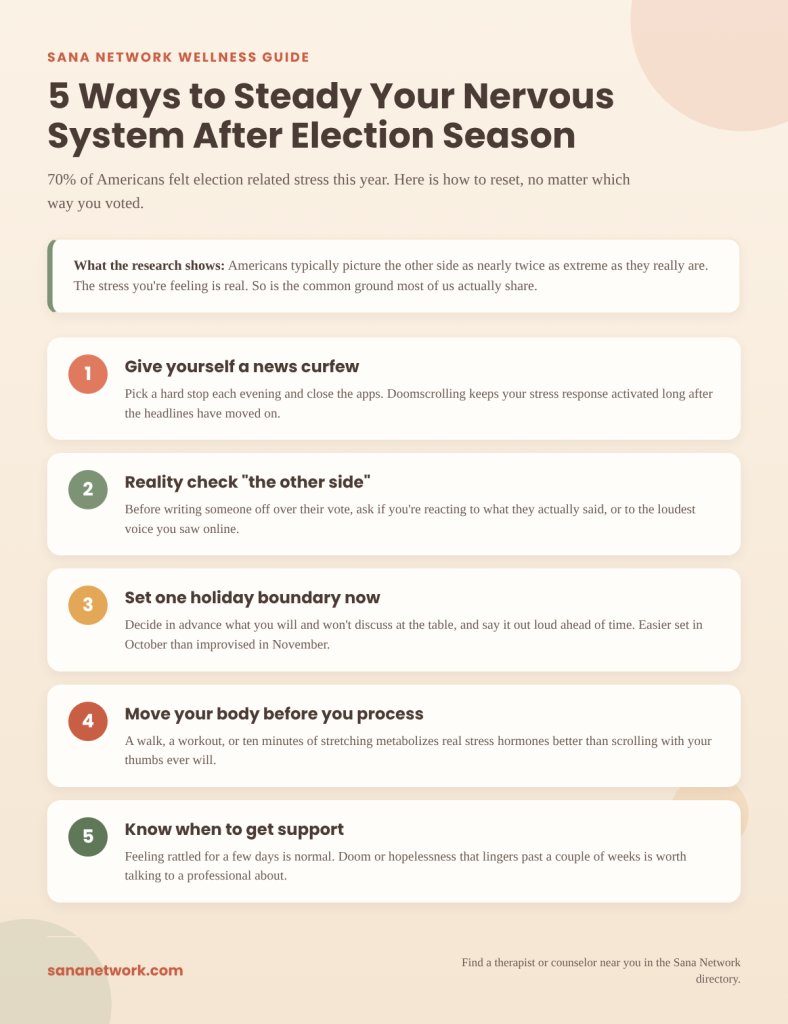
- Give your nervous system a news curfew. Pick a hard stop time each evening to close the apps and the cable news. Doomscrolling keeps your stress response activated long after the news cycle has moved on, and most of what you’d see after 9 p.m. will still be there tomorrow.
- Reality check your assumptions about “the other side.” Before you write off a friend or relative over their vote, ask whether you’re reacting to something they actually said, or to the worst version of their political tribe you’ve seen online. The data says that gap is usually bigger than you think.
- Set one boundary for holiday political talk, right now. Decide in advance what you will and won’t discuss at the table, and say it out loud to your host or family ahead of time (“I’d love to skip politics this year and just catch up”). A boundary set in October beats one improvised mid-argument in November.
- Move your body before you process your feelings. A short walk, a workout, or ten minutes of stretching helps metabolize the actual stress hormones an election dumped into your system. Processing with your thumbs on a screen doesn’t do that the same way.
- Know when this tips into something worth getting support for. Feeling rattled for a few days is expected. Ongoing hopelessness, trouble sleeping, or doom that isn’t lifting after a couple of weeks is worth talking to a professional about, especially if it’s affecting your work, sleep, or relationships.
Find Support Locally
If this election season left you more frayed than usual, whether that’s anxiety, hopelessness, or dread about navigating conversations with people you love, you don’t have to sort through it alone. Sana Network’s free directory connects Tucson area individuals and families with vetted therapists and counselors who can help you process the moment and rebuild the conversations that matter to you. Search anytime at sananetwork.com.
Elections end. How you take care of yourself and the people around you afterward is the part that’s actually up to you.
Written by AI & Reviewed by Clinical Psychologist: Yoendry Torres, Psy.D.
Disclaimer: Some blog posts may contain affiliate links, earning Sana Network a commission at no additional cost to you. These recommendations reflect our honest opinions about products or services we find helpful and trustworthy. This content is informational and not legal nor medical advice; consult an attorney or healthcare provider for personalized guidance.