
Did Your Health Insurance Just Vanish and Nobody Told You?
Picture this. You show up for a routine prescription refill or a kid’s checkup, hand over your insurance card like you’ve done a hundred times, and the person at the […]
Picture this. You show up for a routine prescription refill or a kid’s checkup, hand over your insurance card like you’ve done a hundred times, and the person at the counter says, “I’m sorry, we don’t see active coverage for you.” No letter. No warning text. Just a quiet, confusing gap where your safety net used to be.
That scenario just became a real possibility for a lot of families, on top of a year where ACA marketplace premiums already jumped hard. If you’ve felt a low hum of anxiety about your health coverage lately, you’re not imagining it, and you’re definitely not alone.
The Breakdown
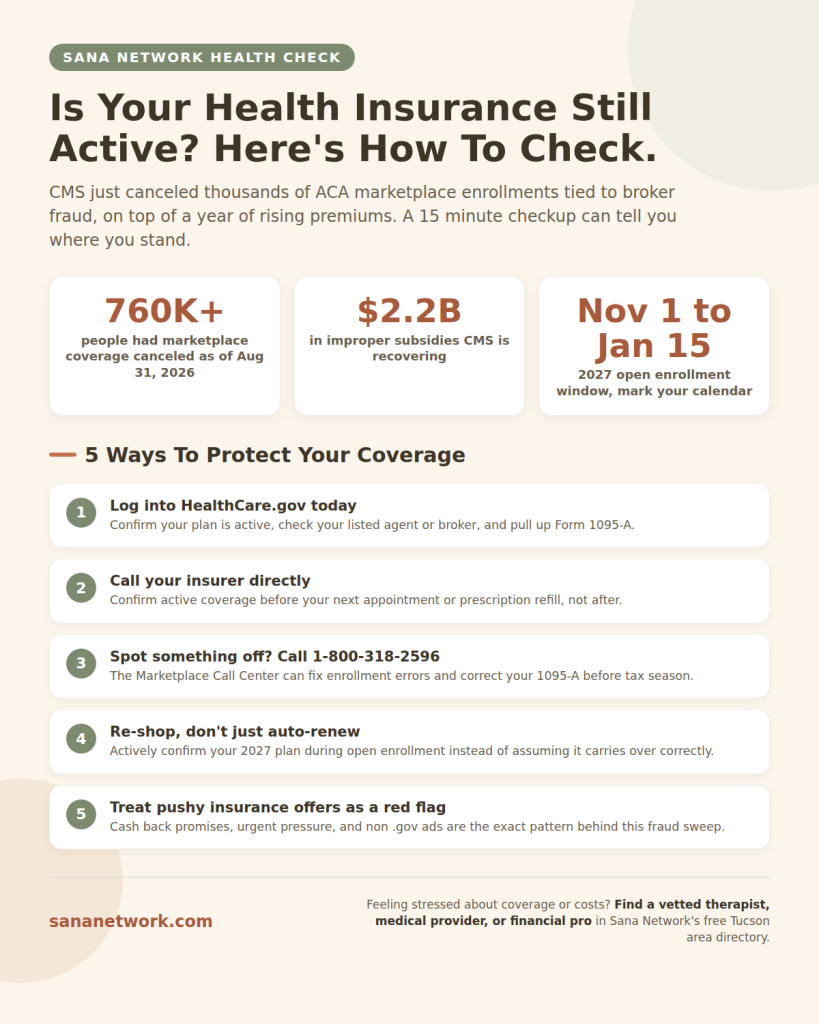
Here’s what actually happened. On September 22, 2026, the Centers for Medicare and Medicaid Services (CMS) announced it had canceled roughly 315,000 marketplace enrollments, affecting more than 760,000 people, effective August 31, 2026. The reason: CMS says these were unauthorized enrollments, people signed up (or switched into a different plan) without their knowledge or consent, often by agents and brokers chasing commissions through misleading social media ads. HHS Secretary Robert F. Kennedy Jr. said the move recovers roughly $2.2 billion in taxpayer funded subsidies tied to those enrollments.
Alongside the cancellations, CMS froze new agent and broker registrations on the federal marketplace through February 1, 2027, and rolled out an interim rule requiring identity verification through Login.gov or ID.me plus electronic consumer authorization before any agent can touch your application. You can find the official notice in the Federal Register under “Temporary Moratoria on Certain Agent and Broker Registration To Participate in the Exchanges.”
Here’s the fine print people are missing: this crackdown landed on top of a coverage year that was already rough. The enhanced premium tax credits that had kept ACA plans affordable since 2021 expired at the end of 2025. According to Kaiser Family Foundation (KFF), the average out of pocket premium payment jumped 58%, from $113 to $178 a month nationally, and that’s after many people downgraded to cheaper bronze plans just to cope; had folks kept their old plans, KFF estimates payments would have more than doubled. Deductibles hit a record average of $3,786, up 37% in a single year. In Arizona specifically, researchers at the University of Arizona estimate 125,000 to 150,000 more residents could end up uninsured in 2026, since roughly 90% of the state’s 423,000 marketplace enrollees (2025 figures) rely on subsidies to afford coverage at all.
So now you’ve got two separate storms hitting the same families at once: premiums that already jumped, and a fraud sweep that can quietly cancel coverage you thought was settled, sometimes without a heads up you’d actually notice. And there’s a tax twist too: starting with the 2026 plan year, the caps on how much you might have to repay the IRS for excess subsidies have been removed, so an enrollment error that isn’t yours could still show up as a surprise bill next spring.
The Human Connection
Money stress and health stress are basically roommates. When you don’t know whether your coverage is real, you start making decisions out of fear instead of facts: skipping a refill “just to be safe,” putting off a checkup, or lying awake doing math about a deductible that used to be manageable. One woman profiled by national news, a single mom earning just above minimum wage, saw her monthly premium jump from three dollars to over $160 practically overnight and had to choose between covering rent and filling a prescription she depends on to get through her day. That’s not a hypothetical. That’s the actual math a lot of households are doing right now.
There’s also a quieter cost: trust. When the system that’s supposed to protect your family’s health instead feels like a maze of forms, brokers, and bureaucratic cleanup, it’s normal to feel angry, powerless, or just exhausted by the whole thing. That reaction isn’t overreacting. It’s a reasonable response to genuine instability, and it deserves to be treated that way rather than something to just push through alone.
Actionable Advice
The good news is that most of this is checkable in about fifteen minutes, and knowing where you stand beats wondering.
- Log into your HealthCare.gov account today. Confirm your plan is active, check who’s listed as your agent or broker, and pull up your Form 1095-A to make sure the details match what you actually signed up for.
- Call your insurer directly before your next appointment or refill. Don’t rely only on the marketplace portal. A two minute call confirming active coverage can save you an unpleasant surprise at the pharmacy counter.
- If something looks off, call the Marketplace Call Center at 1-800-318-2596. Ask about correcting your enrollment or requesting a corrected 1095-A. Fix it before tax season, not after.
- Mark November 1, 2026 through January 15, 2027 on your calendar. That’s open enrollment for 2027 coverage (December 15 is the deadline if you want coverage starting January 1). Actively re-shop and re-confirm your plan this year rather than assuming auto-renewal will carry everything over correctly.
- Treat unsolicited insurance offers like a red flag, not a lead. Promises of guaranteed cash back, pressure to sign up “right now,” or ads that aren’t on an official .gov site are exactly the pattern behind this fraud sweep. When in doubt, go straight to HealthCare.gov or a broker you can verify with your state insurance department.
Find Support Locally
If untangling insurance paperwork has you stressed, anxious, or just plain tired, that’s a completely normal thing to want help with, whether that’s a financial counselor sorting out the practical side or a therapist helping you manage the very real stress underneath it. Sana Network’s free directory connects Tucson area families with vetted therapists, medical providers, and wellness professionals, so you don’t have to sort through it solo. Search anytime at sananetwork.com.
The system had a rough year. Your peace of mind doesn’t have to.
Written by AI & Reviewed by Clinical Psychologist: Yoendry Torres, Psy.D.
Disclaimer: Some blog posts may contain affiliate links, earning Sana Network a commission at no additional cost to you. These recommendations reflect our honest opinions about products or services we find helpful and trustworthy. This content is informational and not legal nor medical advice; consult an attorney or healthcare provider for personalized guidance.