
Your Fall Money Checkup: A Calm Tax Plan for Solo Practitioners
The Envelope You Have Been Avoiding It is a Tuesday evening in October, and Dana, a composite of the many solo therapists we hear from, is finally sitting down with […]
The Envelope You Have Been Avoiding
It is a Tuesday evening in October, and Dana, a composite of the many solo therapists we hear from, is finally sitting down with her bank statements. Her caseload is full. Her clients are doing well. Her practice, by every clinical measure, is thriving. Yet a small knot forms in her stomach as she realizes she cannot remember whether she made her third quarter estimated tax payment last month. She thinks of the mail she has left unopened and the spreadsheet she meant to update in July.
If Dana’s evening sounds familiar, you are in good company. Most of us entered this field to help people heal, not to track deductions or calculate self-employment tax. Yet the quiet weight of unfinished money tasks follows many clinicians into the exam room. The good news is that there is still plenty of time this year to turn that knot into a plan.
What the Latest Data Tells Us
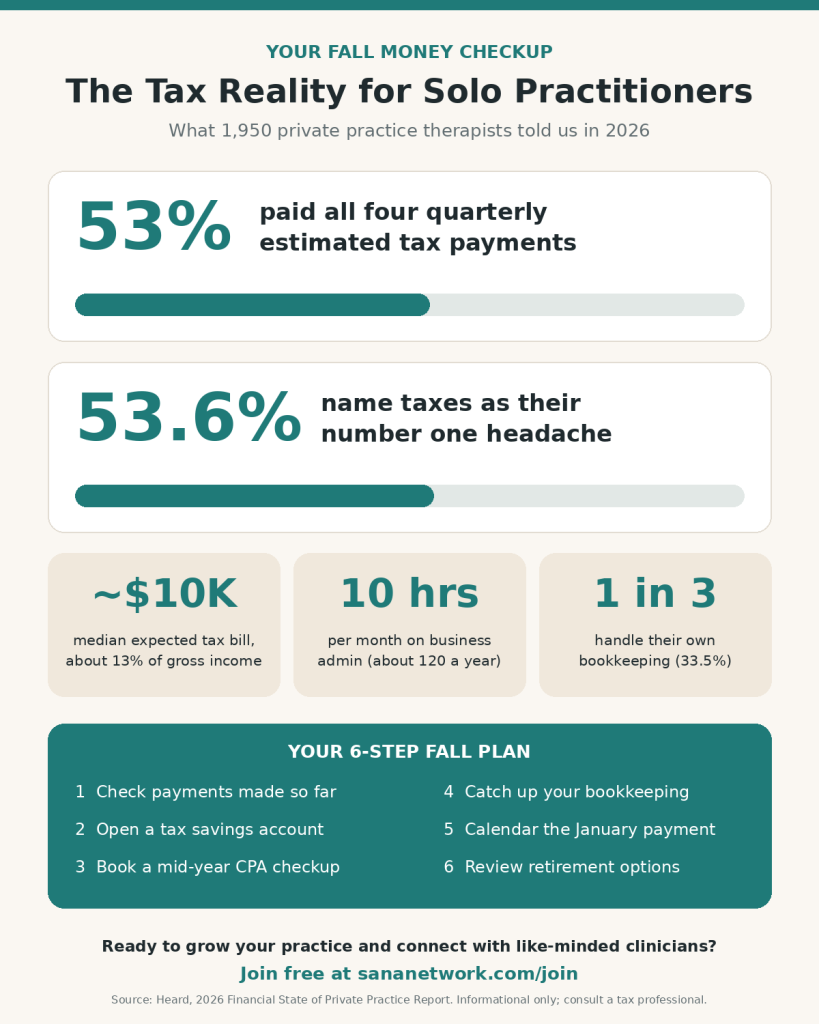
The 2026 Financial State of Private Practice report from Heard surveyed 1,950 therapists across all 50 states and Washington, D.C. Of those respondents, 86.5 percent were solo practitioners. The findings on taxes are striking. Only 53 percent said they paid all four quarterly estimated tax payments, and 53.6 percent named taxes as their number one headache. The median therapist expected a tax bill of roughly $10,000 for the year, about 13 percent of gross income.
Administrative work adds to the load. Respondents reported spending about 10 hours a month on business admin, or roughly 120 hours a year, and about a third handle their own bookkeeping. That is time many of us would rather spend with clients, with family, or simply resting. These numbers are not a verdict on anyone’s competence. They reveal how few of us were ever taught the business side of practice, and how common it is to learn it on the fly.
Why Fall Is the Right Moment
Late September and October sit in a sweet spot for solo practitioners. The year is far enough along that your income patterns are visible, yet there are still weeks left to make thoughtful choices before the calendar closes on December 31. Waiting until the new year often means discovering problems when they can no longer be fixed.
As a self-employed clinician, no employer is quietly withholding taxes from your paycheck. You are the payroll department. That freedom is one of the great benefits of private practice, and it also means the rhythm of setting money aside has to be something you build on purpose. A short, calm review now can reveal whether you are on track, whether a payment has slipped, and whether your business structure still fits the practice you have today.
It also helps to remember that a missed payment is a problem to solve, not a personal failing. Many clinicians discover a gap, talk with a tax professional, and put a simple plan in place that prevents it from repeating. The clinicians who feel most at ease are rarely the ones with perfect records. They are the ones who look at their numbers regularly, ask for help early, and treat their finances as one more part of practice care.
The Business Case for Getting Organized
Tidy finances are not only about avoiding stress. They protect the sustainability of the practice that your clients rely on. When your books are current, you can see what a group program, a workshop, or a lower-cost offering would actually require, and you can design sliding-scale spots that you can afford to keep open. Clear numbers let you say yes to access with confidence rather than worry.
There is also a real time cost. Every hour spent untangling a shoebox of receipts is an hour not spent on outreach, referral relationships, or the rest and recovery that prevent burnout. Small systems, built once, return that time to you month after month.
Consider, too, how financial clarity supports the people you serve. A practice with steady footing can stay open through slow months, keep its doors welcoming to families who need flexibility, and continue investing in referral relationships and community partnerships. Peace of mind about money is not a luxury. It is part of the foundation that lets you show up fully for your clients.
Your Action Plan: 6 Steps to a Calmer Tax Season
- Check your payments so far. Log in to your bank and the IRS online account, and confirm which estimated payments you made this year and for how much. Knowing where you stand is the first step, and it turns a vague worry into a clear number.
- Set up a separate tax savings account. Move a set percentage of every payment you receive into it automatically. I use the Profit First method and schedule transfers every Friday. Ask your accountant what percentage fits your situation, and treat that money as untouchable.
- Book a mid-year checkup with a CPA. Fall is a wonderful time to ask questions while there is still room to act. Bring a simple profit and loss report and a list of your questions about deductions, retirement contributions, and business structure.
- Catch up your bookkeeping. Block two hours on your calendar to categorize expenses from the past three months. If it feels heavy, consider a part-time bookkeeper, since your time has real value.
- Mark your next payment date. The final estimated payment for the year is typically due in mid-January. Confirm the exact date with your tax professional and put it on your calendar with a reminder two weeks ahead.
- Review your retirement and benefits picture. Ask your advisor which retirement accounts suit a solo practitioner, and what year-end contributions could mean for your taxes. Planning for your own long-term wellbeing is part of caring for your practice.
The Bottom Line
You do not need to become an accountant to run a healthy practice. You need a simple rhythm, a trusted professional or two, and a willingness to look at the numbers before they become urgent. Dana opened that envelope, made a plan, and slept better that night. Your practice exists to support your clients and your life. A little attention this fall can help it do both for years to come. Start with one small step this week, and let that first step build momentum toward a calmer, more confident year ahead.
Ready to grow your practice and connect with like-minded clinicians?
Sign up for free and connect with other clinicians in your city. https://sananetwork.com/join/
Written by AI & Reviewed by Clinical Psychologist: Yoendry Torres, Psy.D.
Disclaimer: Some blog posts may contain affiliate links, earning Sana Network a commission at no additional cost to you. These recommendations reflect our honest opinions about products or services we find helpful and trustworthy. This content is informational and not legal nor medical advice; consult an attorney or healthcare provider for personalized guidance.