
Nobody Can Agree on Your Flu Shot This Year. Here’s What to Actually Do About It.
Picture this. You walk into your pharmacy for your yearly flu shot, the same errand you’ve run a dozen times without a second thought. This year the pharmacist pauses, checks […]
Picture this. You walk into your pharmacy for your yearly flu shot, the same errand you’ve run a dozen times without a second thought. This year the pharmacist pauses, checks a screen, maybe makes a phone call, and you leave not knowing if you’ll be billed nineteen dollars or a hundred and forty. Multiply that by every parent wondering if their toddler still needs a COVID shot, every pregnant person asking about RSV, and every grandparent going “wait, do I need one shot or two now?”
If that sounds familiar, you’re not imagining things. This fall, the usual, boring, reliable vaccine routine got a lot more complicated, and it’s not because the science changed. It’s because the people in charge of announcing the science stopped agreeing on how to say it.
The Breakdown
Here’s the short version. The CDC’s vaccine advisory committee, the group that normally sets the national playbook every fall, has been sidelined by leadership changes and legal fights, and hasn’t issued the kind of clear, unified guidance families are used to. Health Secretary Robert F. Kennedy Jr., long skeptical of vaccine safety and effectiveness, pushed for a review of the vaccine schedule, and a presidential memorandum directed federal health agencies to reshape their recommendations.
The practical result: seven vaccines saw changes to how they’re recommended this year, including flu shots with a preservative called thimerosal losing automatic coverage, and, most confusingly, COVID-19 and Hepatitis B vaccines moving to “individual decision-making” rather than a blanket recommendation for everyone.
That single change is causing most of the chaos, because insurance coverage law is built around ACIP’s recommendation status. When a vaccine loses its universal recommendation, insurers make their own calls. Most big insurance trade groups pledged no-cost coverage through the end of 2026, but that pledge doesn’t bind every plan, especially self-insured employer plans, which cover roughly two out of three American workers.
So four major medical groups, the American Academy of Pediatrics, American Academy of Family Physicians, American College of Obstetricians and Gynecologists, and Infectious Diseases Society of America, released their own joint guidance, independent of the federal government, to give families a clear answer. Their bottom line:
- Flu: Nearly everyone age 6 months and up should get vaccinated. Adults 50+ have a new mRNA option showing 27% greater effectiveness in the 50-64 age group.
- COVID-19: Recommended for all adults, with those 65+ getting a fall dose plus a second dose six months later, and for kids 6-23 months.
- RSV: A one-time shot for adults 75+, adults 50-74 with elevated risk, and younger immunocompromised people. Late-pregnancy vaccination protects newborns.
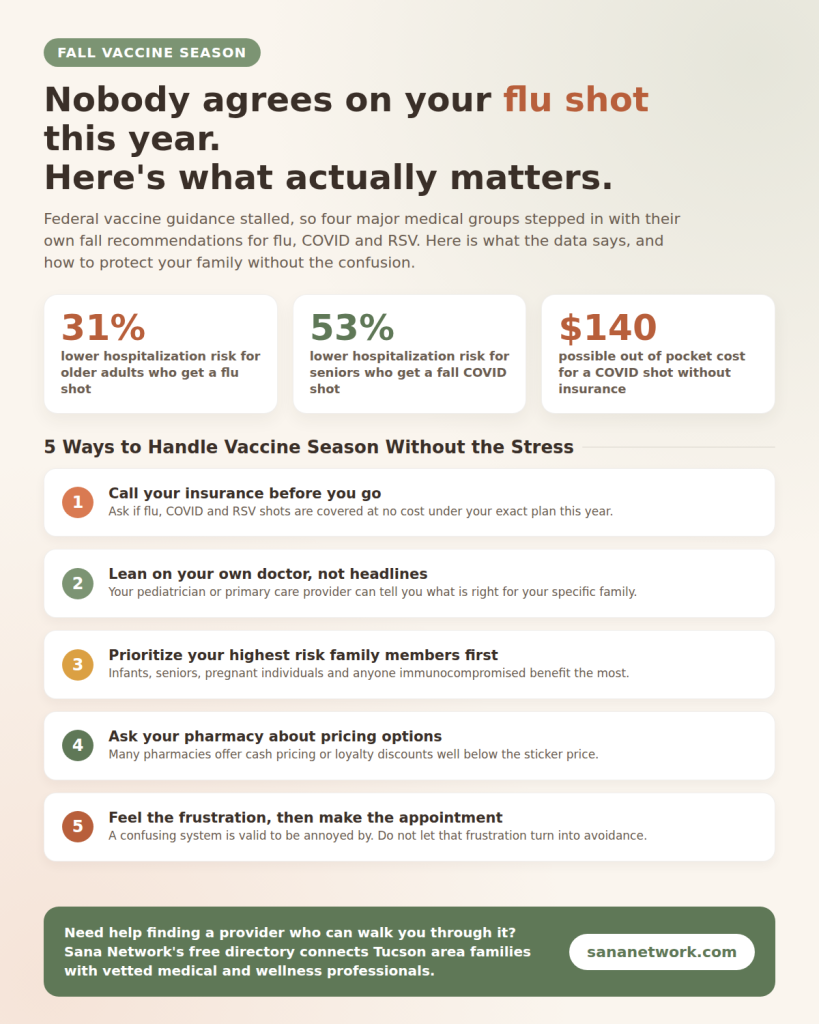
Why bother? The last two flu seasons saw unusually high child deaths, the vast majority in unvaccinated kids. Flu vaccination cuts older-adult hospitalization risk by 31%, and a fall COVID shot cuts senior hospitalization risk by 53%. Meanwhile, without insurance, a COVID vaccine can run up to $140 out of pocket, exactly the kind of number that makes “wait and see” tempting even when it’s risky.
The Human Connection
Here’s the part that doesn’t show up in any policy memo: confusion has a psychological cost, and it lands hardest on people already stretched thin. A pharmacy industry expert summed it up plainly: “confusion is the enemy of vaccine uptake.” When people don’t know if something is safe, recommended, or covered, the easiest response is to just not deal with it and put it off, and that’s exactly how preventable illness spreads through a family, a classroom, or a workplace this winter.
Health related decision fatigue is some of the heaviest kind, tangled up with fear for people we love, worry about money, and a nagging sense we should just “know” the right answer. There’s a financial wellness piece too. Being told a shot might cost nineteen dollars or a hundred and forty, depending entirely on which insurance card is in your wallet, is a genuinely stressful kind of unpredictability. Money stress and health stress feed each other, and when the system itself is inconsistent, feeling overwhelmed by it isn’t a personal failing. It’s a reasonable response to an unreasonable amount of ambiguity.
Actionable Advice
The good news is that this particular kind of stress is manageable with a little bit of legwork done ahead of time, rather than in the pharmacy line.
- Call your insurance before you go, not after. Ask whether flu, COVID, and RSV vaccines are covered at no cost under your exact plan this year. A five minute call can save an unpleasant billing surprise.
- Lean on your own doctor over social media or headlines. Your pediatrician, OB, or primary care provider can tell you what’s right for your specific family, and the new joint guidance is meant as a resource for that individualized conversation.
- Prioritize your highest-risk family members first. If money or time is tight, put your energy toward who benefits most: infants, seniors, pregnant individuals, and anyone immunocompromised.
- Ask your pharmacy about pricing options up front. Many pharmacies offer cash pricing or loyalty discounts well below sticker price, especially for flu shots.
- Let yourself feel annoyed by the chaos, then act anyway. Frustration with a confusing system is valid. Letting it turn into avoidance is where the real risk lives, so name the feeling and make the appointment regardless.
Find Support Locally
If untangling insurance jargon or a confusing health decision feels like more than you want to handle solo, that’s a normal thing to want backup for, whether it’s a primary care provider or a therapist who can help with the underlying stress of decision fatigue. Sana Network’s free directory connects families with vetted medical providers, therapists, and wellness professionals, so you don’t have to sort through the noise alone. Search anytime at sananetwork.com.
The system may be messy this year, but your health decisions don’t have to be. Get the facts, make the call, and take care of your people.
Written by AI & Reviewed by Clinical Psychologist: Yoendry Torres, Psy.D.
Disclaimer: Some blog posts may contain affiliate links, earning Sana Network a commission at no additional cost to you. These recommendations reflect our honest opinions about products or services we find helpful and trustworthy. This content is informational and not legal nor medical advice; consult an attorney or healthcare provider for personalized guidance.
Sources (for Dr. Torres to verify before publishing)
1. PBS NewsHour, “Top U.S. doctors offer updated flu and COVID vaccine recommendations, aiming to ease confusion” (joint guidance from AAP, AAFP, ACOG, IDSA; flu/COVID/RSV recommendations; hospitalization-reduction stats): https://www.pbs.org/newshour/health/top-u-s-doctors-offer-updated-flu-and-covid-vaccine-recommendations-aiming-to-ease-confusion
2. KFF, “Recent Changes in Federal Vaccine Recommendations: What’s the Impact on Insurance Coverage?” (7 vaccines changed; COVID/Hep B moved to individual decision-making; insurer no-cost pledge through 2026; self-insured plan coverage gap): https://www.kff.org/other-health/recent-changes-in-federal-vaccine-recommendations-whats-the-impact-on-insurance-coverage/
3. NBC News, “For some, fall Covid shots may come with copays, or no coverage at all” (up to $140 out-of-pocket cost without insurance; coverage varies by plan): https://www.nbcnews.com/health/health-news/-fall-covid-shots-may-come-copays-no-coverage-rcna226160
4. Commonwealth Fund, “New Vaccine Recommendations Could Lead to Coverage Headaches” (shared clinical decision-making ambiguity; payer confusion risk): https://www.commonwealthfund.org/blog/2026/new-federal-vaccine-recommendations-introduce-ambiguity-and-could-lead-coverage-headaches
5. Drug Topics, “ACIP’s Vacancy Leaves Pharmacists Navigating COVID-19 Confusion” (pharmacist-level operational confusion; “confusion is the enemy of vaccine uptake” quote from Dr. Goad; ACIP quorum issue): https://www.drugtopics.com/view/acip-s-vacancy-leaves-pharmacists-navigating-covid-19-confusion